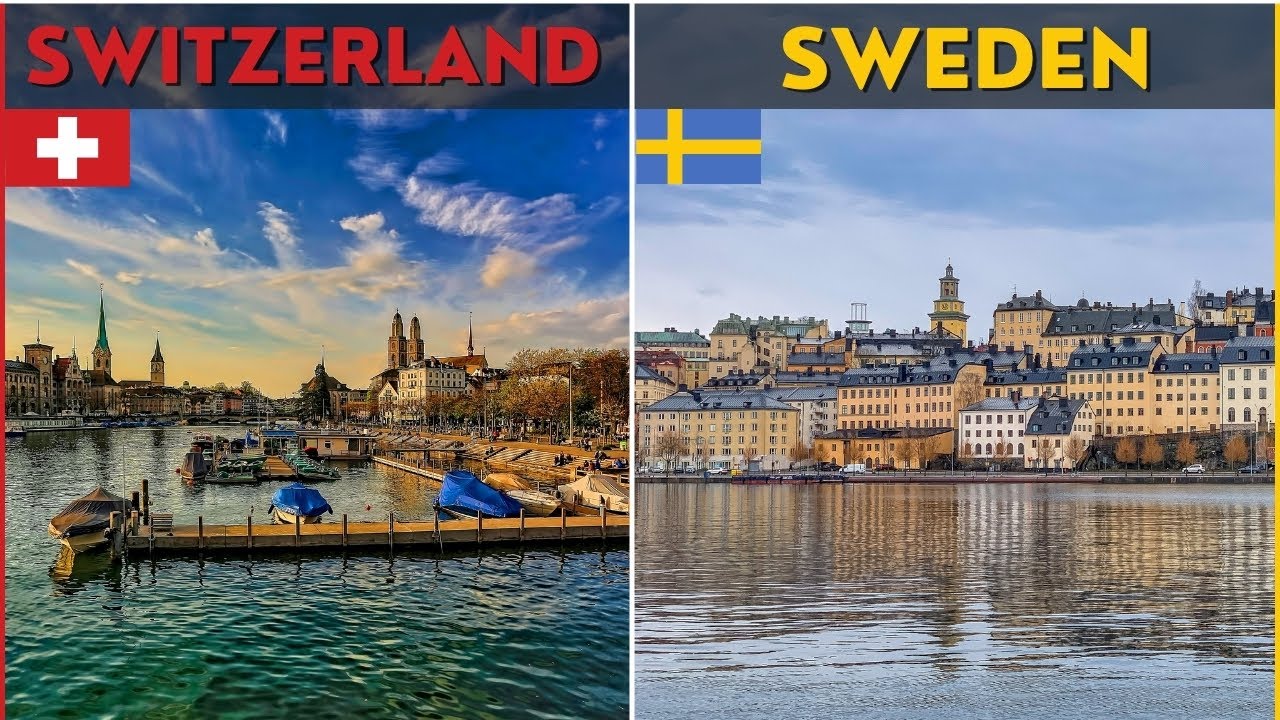
sweden vs switzerland Switzerland are frequently confused due to their similar English spelling patterns and shared initial “Sw”. Many people also assume they are geographically close or culturally similar, but in reality, they represent two completely different European identities. One belongs to the Nordic region, while the other sits in the heart of the Alps. This confusion is common among travelers, students, and general knowledge seekers, especially when first encountering European geography.
The similarity in naming is the first psychological trigger. However, beyond the names, both countries also appear in global rankings for quality of life, innovation, and safety, which further strengthens the confusion. Despite these surface similarities, their history, climate, economy, and lifestyle differ significantly.
Geographic Location and Natural Landscape Differences
Sweden is located in Northern Europe, forming part of Scandinavia along with Norway and Denmark. It stretches across a long vertical landmass with vast forests, thousands of lakes, and coastal archipelagos. Its terrain is generally flat to gently rolling in the south and becomes more forest-dense and Arctic-like in the north.
Switzerland, on the other hand, is a landlocked country in Central Europe surrounded by France, Germany, Italy, and Austria. It is famous for the Alps, which dominate its landscape. Unlike Sweden’s expansive forests and lakes, Switzerland is defined by dramatic mountain ranges, steep valleys, and glacial lakes.
A key difference lies in accessibility and terrain usage. Sweden’s landscape supports forestry, outdoor recreation, and large-scale urban planning, while Switzerland’s geography is more suited to tourism, hydropower, and alpine agriculture.
Climate Comparison and Seasonal Experience
Sweden experiences a Nordic climate, meaning long, cold winters in the north and milder conditions in the south. In the northern regions, phenomena like the midnight sun and polar nights occur, where daylight can last 24 hours in summer or disappear in winter.
Switzerland has a temperate alpine climate. Winters are cold in mountainous areas with heavy snowfall, making it a global skiing destination. Summers are relatively warm and pleasant, especially in lower altitudes and cities like Zurich and Geneva.
The emotional experience of seasons differs greatly. Sweden offers extended summer daylight and quiet winter landscapes, while Switzerland provides high-adrenaline winter sports and scenic mountain tourism throughout the year.
Population Structure and Urban Lifestyle
Sweden has a population spread across a few major cities such as Stockholm, Gothenburg, and Malmö. The rest of the country consists of sparsely populated rural and forest areas. This creates a balanced urban-rural lifestyle with strong emphasis on sustainability and public services.
Switzerland has a more concentrated urban network, with major cities like Zurich, Geneva, Basel, and Bern located relatively close to each other. Despite its small size, Switzerland has a dense population distribution and highly efficient infrastructure connecting cities through rail and road systems.
Urban life in Sweden tends to be spacious, calm, and socially balanced, while Switzerland’s cities are compact, highly organized, and economically intense.
Economic Structure and Global Position
Sweden has a strong mixed economy driven by technology, manufacturing, and services. It is home to global brands and a highly innovative startup ecosystem. The country also emphasizes welfare systems, ensuring healthcare, education, and social security are widely accessible.
Switzerland is globally recognized for its financial sector, banking system, pharmaceuticals, and high-precision industries such as engineering and watchmaking. It is one of the wealthiest countries in the world in terms of GDP per capita and has a strong export-driven economy.
While Sweden focuses on innovation and social welfare balance, Switzerland focuses on financial stability, high-end services, and global trade specialization.
Cost of Living and Lifestyle Quality
Sweden offers a relatively high cost of living compared to global standards, but it is balanced by extensive public services. Citizens benefit from subsidized healthcare, education, and parental support systems, making daily life more socially supported.
Switzerland is known for one of the highest costs of living globally. However, this is matched by high salaries and strong purchasing power. Everyday expenses such as housing, insurance, and transportation are significantly expensive, but the quality of services is extremely high.
Lifestyle in Sweden leans toward equality, social comfort, and work-life balance. Switzerland emphasizes efficiency, productivity, and financial strength.
Cultural Identity and Social Behavior
Swedish culture is deeply rooted in concepts like “lagom,” meaning balance and moderation. Society values equality, privacy, and collective well-being. People tend to be reserved but friendly, with strong community systems and progressive values.
Swiss culture is influenced by multiple linguistic regions including German, French, Italian, and Romansh. This makes Switzerland culturally diverse despite its small size. Swiss society values precision, punctuality, neutrality, and professionalism.
Both countries are highly developed socially, but Sweden is more socially liberal and uniform, while Switzerland is more traditional and regionally diverse.
Education and Innovation Systems
Sweden has a strong public education system with free access to higher education for EU citizens and structured support for international students. It is also a leader in research, sustainability, and digital innovation.
Switzerland is home to some of the world’s top-ranked universities and research institutions. It excels in science, engineering, and business education. The country invests heavily in innovation and has strong industry-academia collaboration.
Both countries are global education leaders, but Sweden focuses more on accessibility, while Switzerland emphasizes elite academic excellence.
Tourism Appeal and Travel Experience
Sweden attracts tourists with its natural beauty, northern lights, forest retreats, and modern cities. Popular experiences include exploring Lapland, Stockholm’s archipelago, and traditional Nordic culture.
Switzerland is one of Europe’s top tourist destinations, known for the Alps, ski resorts, scenic train routes, and luxury mountain towns. Cities like Lucerne and Interlaken are globally famous for postcard-like landscapes.
Sweden offers peaceful, nature-based exploration, while Switzerland offers dramatic scenery and luxury alpine tourism.
Infrastructure and Transportation Systems
Sweden has a well-developed but geographically spread transportation system. High-speed trains, buses, and domestic flights connect major cities, but long distances between regions make travel time longer.
Switzerland is globally famous for its extremely efficient transportation system. Trains, trams, and buses operate with high precision and connectivity, even in mountainous regions. Public transport punctuality is one of the best in the world.
The key difference is density versus precision: Sweden covers more land with longer distances, while Switzerland optimizes compact geography with maximum efficiency.
Key Differences Summary for Quick Understanding
Sweden is:
- Large, forest-rich Nordic country
- Focused on social welfare and equality
- Calm, spacious lifestyle
- Innovation-driven economy
- Long seasonal daylight variation
Switzerland is:
- Small, mountainous Central European country
- Finance and precision-focused economy
- High-cost, high-efficiency lifestyle
- Diverse multilingual culture
- World-famous alpine tourism destination
Final Insight: Which Country Stands Out More
Sweden and Switzerland cannot be judged as better or worse because they serve completely different lifestyles and global roles. Sweden excels in sustainability, social systems, and natural living environments, while Switzerland leads in financial strength, infrastructure efficiency, and alpine tourism prestige.
The confusion between them is understandable at first glance, but once examined closely, they represent two entirely different European identities—one shaped by forests and social balance, the other by mountains and precision-driven excellence.
A clearer understanding of both countries helps travelers, students, and researchers make informed choices based on lifestyle preference, career goals, and travel expectations rather than name similarity.