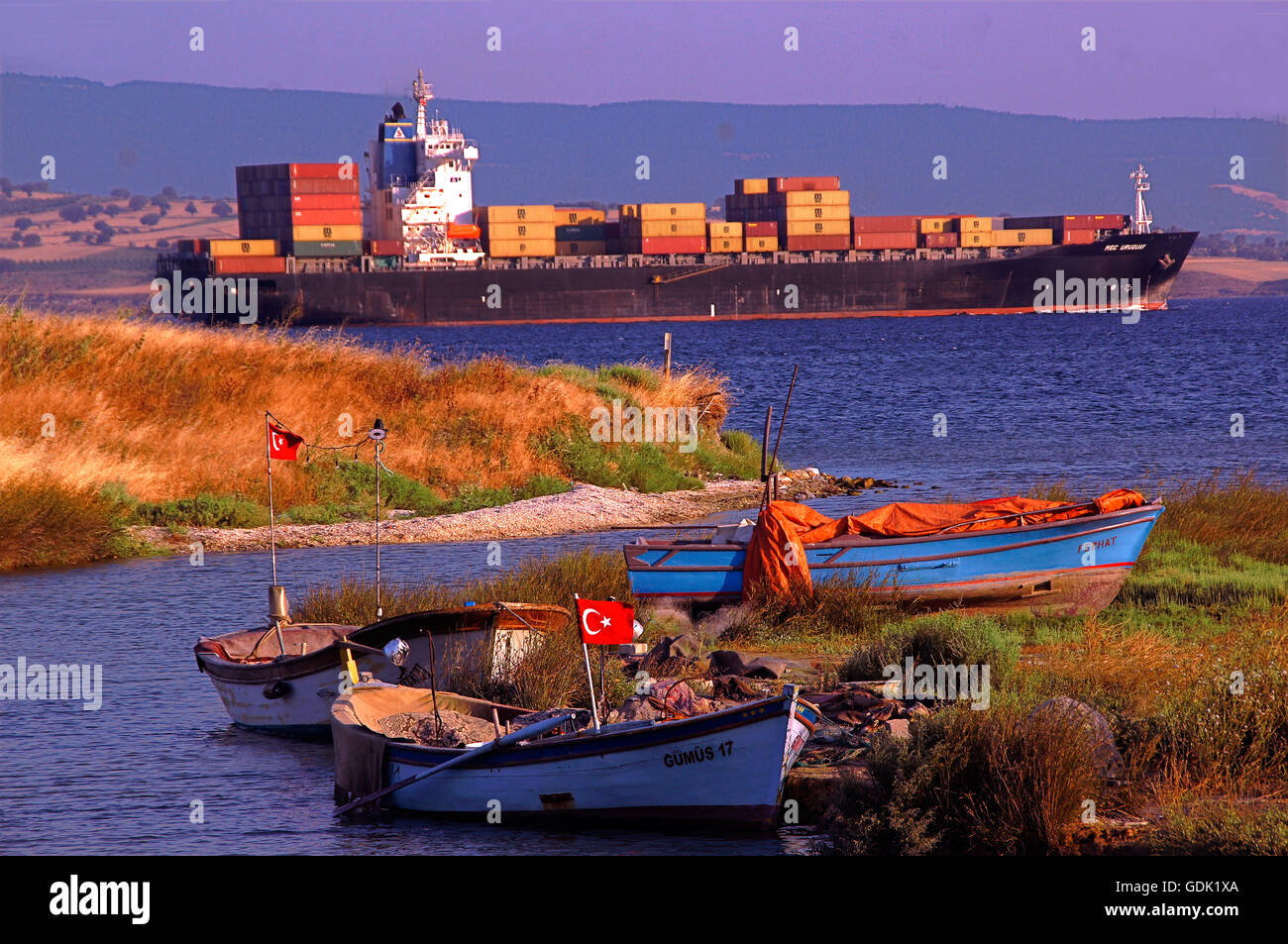
The Hellespont and Dardanelles refer to the same crucial waterway that separates Europe and Asia while connecting the Aegean Sea to the Sea of Marmara. This narrow but highly strategic strait has shaped empires, inspired myths, and influenced global military history for thousands of years. Its significance is not only geographic but also cultural, economic, and symbolic. From ancient Greek legends to modern geopolitical importance, this water passage has remained one of the most influential maritime corridors in human civilization. It represents both a physical boundary and a historical bridge between worlds.
Geographic Reality: A Natural Corridor Between Two Continents
The strait is located in northwestern Turkey and stretches approximately 61 kilometers in length. Its width varies significantly, ranging from about 1.2 kilometers at its narrowest point to over 6 kilometers in wider sections. It serves as the only maritime outlet from the Sea of Marmara to the Aegean Sea, making it a key part of the larger Turkish Straits system along with the Bosporus. The waterway experiences strong surface currents flowing from the Black Sea toward the Mediterranean, with countercurrents beneath, creating a complex navigational environment. Its steep coastal geography and narrow channels have historically made it both a natural defense barrier and a maritime challenge.
Mythological Origins: The Tragedy of Helle and the Naming of Hellespont
The ancient name “Hellespont” originates from Greek mythology, specifically the story of Helle. According to legend, Helle and her brother Phrixus fled on a golden ram sent by the gods. During the journey, Helle fell into the sea and drowned in the narrow strait, which was then named “Hellespont,” meaning “Sea of Helle.” This myth reflects how ancient civilizations interpreted natural geography through storytelling. The strait became a symbolic boundary between life and death, safety and danger. The mythological identity of the Hellespont adds a cultural and emotional layer to what is otherwise a strategically significant waterway.
Ancient Greek Importance: Naval Power and Mythic Geography
During the classical Greek period, the Hellespont held immense strategic importance. It was a crucial passage for trade and military movement between the Aegean and the Black Sea regions. City-states such as Athens depended on grain imports from the Black Sea, making control of the strait vital for survival. Famous historical events, including the Persian Wars, saw military campaigns and naval strategies centered around this narrow passage. The Persian king Xerxes is said to have built a pontoon bridge across the Hellespont during his invasion of Greece, demonstrating its strategic and symbolic importance. Control of the strait often meant control of economic lifelines and military advantage.
Roman and Byzantine Influence: A Gateway of Imperial Power
Under Roman and later Byzantine rule, the Dardanelles remained a critical maritime corridor. Constantinople’s proximity to the strait allowed the Byzantine Empire to control trade routes between Europe and Asia effectively. The strait functioned as both a defensive barrier and a commercial artery. Fortifications were built along its shores to monitor and regulate naval traffic. During this era, the waterway became a heavily regulated zone, with imperial authority controlling passage rights. The strategic importance of the strait continued to grow as Mediterranean trade networks expanded, reinforcing its role as a gateway between continents.
Ottoman Era: Strategic Control and Military Dominance
With the rise of the Ottoman Empire, the Dardanelles gained even greater strategic importance. The Ottomans recognized that controlling this narrow passage meant controlling access between the Mediterranean and the Black Sea. Fortresses such as Kilitbahir and Çimenlik were constructed to secure naval dominance. The strait became a critical defense line against European naval powers. Ottoman control ensured regulation of trade routes and military movements, strengthening their geopolitical influence. The Dardanelles served not only as a military checkpoint but also as an economic gateway that contributed to the empire’s long-term stability.
World War I and the Gallipoli Campaign: A Defining Military Theater
One of the most significant historical events associated with the Dardanelles is the Gallipoli Campaign during World War I. The Allied forces launched a naval and land operation aiming to seize control of the strait, open a supply route to Russia, and potentially knock the Ottoman Empire out of the war. The campaign involved intense naval battles, amphibious landings, and prolonged trench warfare along the Gallipoli Peninsula. Despite extensive efforts, the operation failed due to strong Ottoman defense, difficult terrain, and strategic miscalculations. This campaign became a defining moment in military history and is remembered for its heavy casualties and tactical lessons. It also played a crucial role in shaping national identities, particularly in Turkey, Australia, and New Zealand.
Modern Strategic Importance: A Global Maritime Chokepoint
In the modern era, the Dardanelles continues to hold significant geopolitical importance. It remains one of the busiest maritime chokepoints in the world, regulating access between the Black Sea and global oceans. International treaties govern its usage, ensuring freedom of navigation while maintaining regional security. The strait is essential for commercial shipping, especially for countries dependent on Black Sea trade routes. Its strategic value extends into energy transportation, military logistics, and international maritime law. Control and regulation of this passage continue to be important factors in regional diplomacy and global trade stability.
Cultural and Symbolic Meaning: A Bridge Between Worlds
Beyond its military and economic importance, the Hellespont and Dardanelles carry deep cultural symbolism. They represent the division and connection between Europe and Asia, often viewed as a metaphorical boundary between civilizations. In literature and art, the strait has been portrayed as a place of crossing, transformation, and confrontation. Ancient poets and historians frequently referenced it as a symbol of ambition, conquest, and human struggle against natural forces. The myth of Helle combined with historical battles gives the strait a layered identity where mythology and reality coexist.
Navigation and Maritime Challenges: Nature’s Strategic Barrier
Navigating the Dardanelles is not simple due to its strong currents, narrow passages, and frequent traffic congestion. The surface current flows from the Black Sea toward the Aegean, while an undercurrent flows in the opposite direction, creating complex hydrodynamic conditions. Ships must carefully time their passage to avoid collisions and maintain control. These natural conditions have historically contributed to its defensive advantage, as naval operations in the strait require precise coordination. Even in modern times, maritime authorities regulate traffic to ensure safety and efficiency in this high-density shipping lane.
Environmental and Geological Characteristics: A Dynamic Water System
Geologically, the strait was formed through tectonic activity and sea level changes over thousands of years. It is part of a larger fault system in the region, making it an area of geological interest. The mixing of saltwater from different seas creates a unique marine ecosystem with diverse aquatic life. Environmental conditions in the strait are influenced by seasonal currents, salinity differences, and human maritime activity. These factors contribute to both ecological richness and environmental vulnerability, requiring ongoing monitoring and conservation efforts.
Modern Turkey and Regional Significance: A National Asset
Today, the Dardanelles is a vital national asset for Turkey, both economically and strategically. It serves as a controlled international waterway under the Montreux Convention, which regulates naval passage through the Turkish Straits. The strait contributes significantly to maritime trade revenue and regional influence. It also holds cultural importance as a historical landmark that reflects Turkey’s deep historical connections with ancient civilizations and global conflicts. The surrounding region has become a point of historical tourism, attracting visitors interested in both ancient mythology and World War I history.
Conclusion: A Timeless Corridor of History, Myth, and Power
The Hellespont and Dardanelles are more than just a narrow body of water; they represent a continuous thread through human civilization. From mythological origins rooted in tragedy to strategic military campaigns that shaped empires, this strait has remained central to history. Its geographic position has made it a focal point of trade, warfare, and cultural exchange. Even today, it continues to influence global maritime routes and regional geopolitics. Understanding this strait means understanding the intersection of nature, mythology, and human ambition across thousands of years.